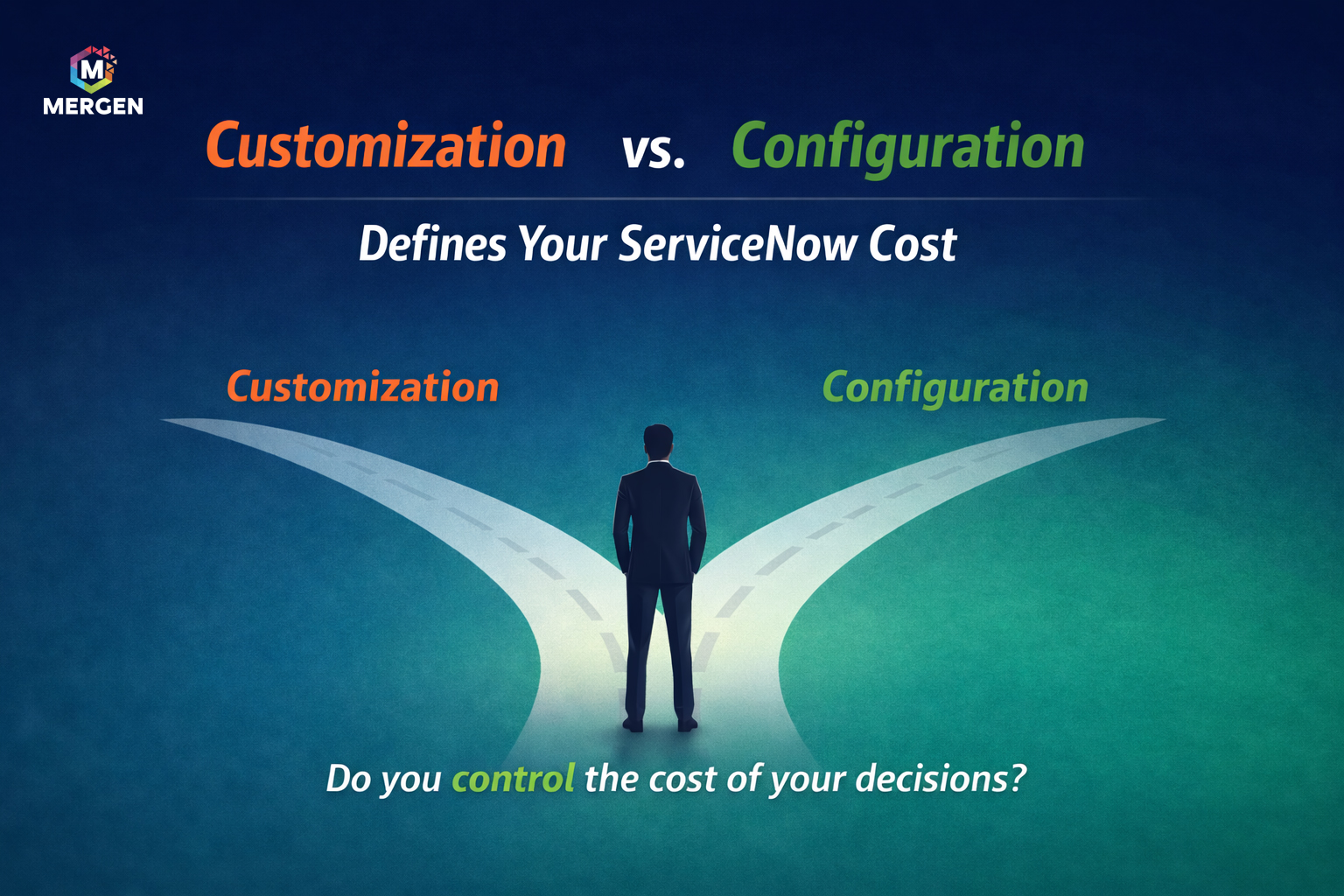
Every customization feels justified in the moment. Here’s why the ones that felt most justified are the ones costing you the most.
Most organizations are unaware of a ServiceNow problem bubbling up until the symptoms start showing up in daily operations. An upgrade that should take 6 to 8 hours is taking 2 to 3 weeks. Teams stop delivering new capabilities because they are stuck fixing what already exists. Backlogs grow, and 40 to 60 percent of open work is maintenance, instead of innovation.
This cannot be chalked up to a platform failure. It is a decision pattern that compounds over time.
Organizations that extract the most value from ServiceNow Managed Services are not the ones that avoid customization completely. They are the ones who understand when customization creates value and when it quietly becomes a long-term liability.
Most teams use “configuration” and “customization” as if they mean the same thing. They do not. That confusion is where long-term problems begin.
Configuration means working within what ServiceNow already provides. You adjust forms, workflows, rules, and automation using built-in capabilities. The platform is designed for this. Upgrades expect this.
Customization means changing how the platform behaves at a deeper level. You write custom scripts, modify core logic, or build functionality that duplicates what the platform might eventually offer. The platform does not assume this. Upgrades do not protect it.
The difference is simple. Configuration works with the platform. Customization works around it. Neither is wrong. But they lead to very different outcomes.
Most teams only appreciate configuration after they have already over-customized their instance. When your instance stays close to out-of-the-box capabilities, upgrades become routine. Systems move forward without requiring weeks of validation and rework.
What this looks like in real terms
|
Scenario |
Upgrade Times |
|
Well-configured instance |
6 to 8 hours |
|
Heavily customized instance |
2 to 3 weeks |
The difference is not only technical; it directly affects how quickly your business can adopt new capabilities.
There is also a second effect that becomes visible over time. When systems are built through configuration:
Configuration does not solve everything. Trying to force every business process into standard functionality creates a different kind of problem. This is where many teams make the wrong trade-off. They avoid customization to reduce technical complexity but end up increasing operational complexity.
What this looks like:
The cost does not disappear. It simply shifts into process efficiency and user frustration. The real question is not whether something can be configured. It is whether forcing configuration creates more friction than it removes.
There are cases where customization is the right decision. Some workflows are core to how your organization operates. If those workflows create a competitive advantage, forcing them into standard behavior can weaken your operations.
Integration is another reality. Many enterprises are still dependent on systems that were not designed for modern integration standards. Standard connectors cannot always bridge these environments. Custom integration logic becomes necessary.
In these cases, customization becomes a strategic requirement, not excess.
The real cost of customization is rarely visible during implementation. It shows up every time ServiceNow releases an update, and then your team must check whether custom logic still works. If it does not, someone needs to fix it. This repeats with every release cycle.
Over time, this creates a pattern:
The bigger issue is what brews underneath. Customization adds both functionality and weight to the system. As logic is layered in, dependencies and complexity increase, making changes unpredictable. This is how systems gradually become hard to manage. Structured systems become difficult to upgrade, navigate, or trust.
Even small customizations collectively slow the system, causing delays that users notice. When that happens, users stop trusting the platform, leading to a decline in adoption and affecting the value of the entire investment.
Customization problems are rarely caused by technical limitations. They are caused by decision patterns. Common signals include:
One of the most overlooked issues is documentation, not of code, but of intent. When teams do not capture why something was built, future teams are unable to modify or remove it; redundant logic continues to exist, and every upgrade becomes a risk assessment exercise.
Over time, these decisions compound into a system that is harder to manage and more expensive to operate. This is often mistaken for a development issue. In reality, it is a governance problem.
At Mergen, the focus is not on avoiding customization. It is on controlling when, why, and how it exists.
Built Only What Survives Multiple Release Cycles: Every customization is evaluated against one question: will this still make sense after multiple platform upgrades? If the answer is unclear, the default is not to be built. This prevents short-term decisions from becoming long-term liabilities.
Treat Customization as a High-Cost Asset: Customization is not treated as a default response. It is treated as something that must justify its existence. Each request is evaluated against business impact, maintenance overhead, upgrade compatibility, and long-term ownership. This ensures that customization supports the business instead of hidden effort.
Maintain Continuous Visibility into Platform Health: Most organizations do not know how much of their instance (or system) is customized. That lack of visibility creates risk. A structured ServiceNow Managed Services approach includes:
Each removal reduces maintenance overhead permanently.
When customization is controlled and governance is consistent, the system behaves very differently.
The platform evolves with the business instead of slowing it down. This is not achieved by avoiding change. It is achieved by making disciplined decisions about what should change.
Is Your ServiceNow Instance Working Against You
Can you answer the following questions?
Q. How much of your system is customized?
Q. How much effort is spent maintaining it?
If you cannot measure it, you cannot control it.
Start with this: How long did your last upgrade take? How much of that time was spent reviewing or fixing custom logic?
If the second answer is unclear, that is where the problem begins. Because what you cannot see is usually what is slowing you down.
The challenge is not choosing between customization and configuration. The challenge is knowing when one starts hurting more than it helps.
Each decision makes sense individually, but not together. This is where ServiceNow Managed Services needs to do more than keep the system running. It needs to bring structure to how decisions are made.
At Mergen, the focus is to understand what is adding value, remove what is adding effort, and ensure future decisions do not recreate the same problems.
If your upgrades are taking longer than expected, or your team is spending more time maintaining than building, the problem is already inside the system. Not all organizations are blessed with a clear view of how much complexity they are carrying.
Connect with Mergen to assess your ServiceNow environment and identify what is driving maintenance overhead, upgrade delays, and system complexity before it compounds further.
Allow our IT professionals to identify your company's needs and help you
save time and the cost of your business.


