ServiceNow was never meant to be a static infrastructure. It evolves continuously by introducing new release families, AI-driven automation, and enterprise workflow capabilities that reshape how organisations operate.
The challenge is not adoption; it is evolution.
Many enterprises start with in-house ownership but soon find the platform’s pace outstrips their operating model. ServiceNow introduces two releases annually, requiring regular upgrades to stay supported and benefit from innovation.
The result is a shift from innovation to maintenance, with a gap forming between platform potential and effective management. This is the “ServiceNow trap”—internal management increasingly constrains growth, highlighting the risk of underusing the platform’s capabilities.
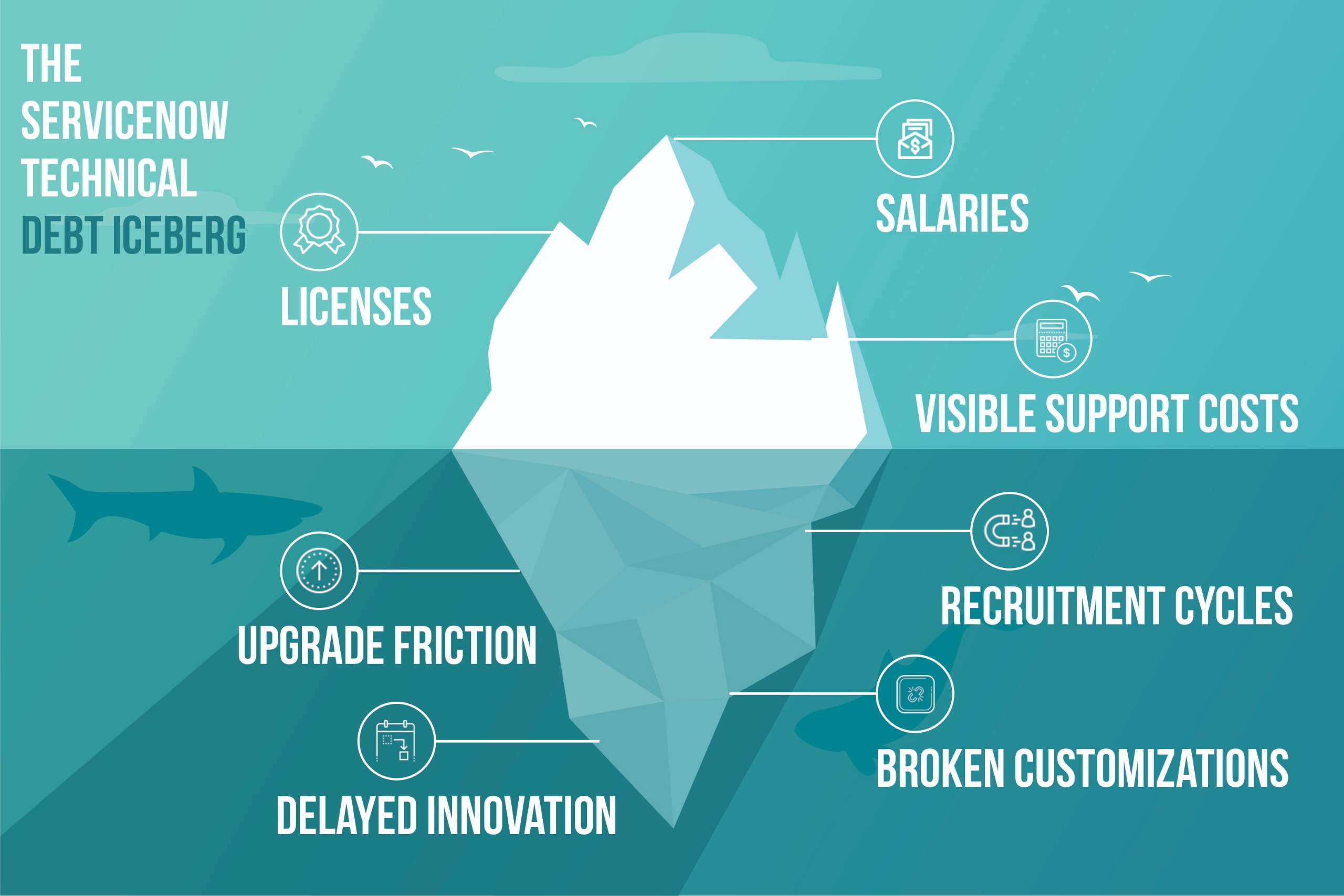
The debate between managed services and in-house management is often framed around staffing costs. Yet the most significant expenses associated with ServiceNow rarely appear on payroll lines; they emerge through technical debt, delayed upgrades, and operational friction.
Research from McKinsey shows that technical debt can account for 20-40% of a technology estate’s value, slowing modernisation and diverting resources away from innovation. Their research highlights that early implementation decisions and inconsistent development practices can significantly increase lifecycle costs and extend upgrade timelines.
In ServiceNow environments, this debt accumulates quietly. Quick customisations solve immediate problems but increase upgrade complexity over time, turning routine releases into high-risk events. Since ServiceNow introduces major release families regularly, falling behind quickly limits access to new capabilities and security enhancements.
Talent continuity introduces another layer of hidden cost.
Gallup estimates that replacing technical professionals can cost up to 80% of an employee's annual salary, but the deeper loss is institutional knowledge, such as undocumented workflows, architectural intent, and governance decisions.
This is where specialist managed services, such as those delivered by Mergen IT, begin to change the equation. Instead of relying on individual expertise, organisations gain institutional continuity: structured architecture, consistent governance, and operational resilience that extends beyond employee turnover.
The question isn’t whether in-house management works; it clearly does in early stages. The more relevant question is whether it remains sustainable as ServiceNow expands into AI-driven automation, enterprise workflows, and cross-functional transformation.
Recent platform updates introduced thousands of preconfigured AI agents designed to streamline work across IT, HR, and CRM environments, reinforcing how quickly the ecosystem is evolving. ServiceNow continues to position the Now Platform as an enterprise-wide productivity engine rather than a single IT tool.
Maintaining expertise across architecture, governance, security, and AI capabilities requires depth that most internal teams struggle to scale on their own. Managed services provide access to multidisciplinary expertise without the delays of recruitment or the risk of over-customisation.
Governance is another critical differentiator. Internal teams often prioritise delivery speed, which can lead to a customisation-first approach that creates long-term friction. Specialist partners like Mergen IT reinforce Out-of-the-Box design principles, ensuring upgrades remain smooth and the platform stays aligned with ServiceNow’s evolving roadmap.
Security and compliance expectations are also rising. As AI becomes embedded within workflows, organisations must move from reactive patching toward proactive governance, a model that structured managed services are designed to support.
In-house teams bring deep organisational knowledge, and their role remains essential. However, as ServiceNow environments mature, internal models often encounter structural challenges that are difficult to overcome without specialist support.
Scaling the platform requires expertise across multiple modules and integrations. Hiring that breadth internally is both costly and time-consuming, especially as demand for ServiceNow specialists continues to grow globally. Even highly capable internal teams can find themselves prioritising operational stability over strategic innovation simply due to capacity constraints.
The outcome is not failure; it is stagnation. The platform runs reliably, but its potential remains underutilised.
Forward-looking organisations move to managed services not because in-house teams lack capability, but because the platform’s trajectory requires a different operating model.
Many organisations begin by managing ServiceNow the same way they manage other enterprise applications. At first, that path feels practical (build quickly, adapt as needed, and respond to immediate business demands). Over time, however, these early directions can lead to greater customisation and inconsistent standards, slowing upgrades and making the platform hard to evolve.
Some organisations pause at this point and reconsider how the platform should be guided going forward. Rather than reacting to change, specialist partners such as Mergen IT bring a steady, long-term perspective, ensuring that each decision supports future growth as much as the present needs. We’ve explored this approach further in our perspective on how managed service providers help enterprises unlock the full value of ServiceNow and maximize long-term ROI.
By following proven platform practices, maintaining clear documentation, and preparing continuously for upcoming releases, managed services help organisations move beyond simply maintaining ServiceNow, allowing it to mature into a stable, forward-looking asset that supports broader business goals.
The decision between in-house management and managed services is ultimately about the future role of ServiceNow within the enterprise.
In-house teams often succeed in establishing the platform, but sustained innovation requires a level of specialisation and governance that becomes increasingly difficult to maintain internally. As ServiceNow accelerates its investment in AI, automation, and enterprise workflows, organisations are recognising that the traditional in-house model is rarely the most effective long-term strategy.
This is why managed services, particularly those delivered by ServiceNow specialists like Mergen IT, are emerging as the preferred operating model. They provide the depth, continuity, and architectural discipline required to keep pace with the platform’s evolution while allowing internal teams to focus on strategic outcomes rather than day-to-day maintenance.
The key takeaway: managed services offer more than replacement for internal ownership—they enable organisations to move beyond maintenance and achieve enterprise transformation with ServiceNow.
30-Second Self-Assessment
Q 1. Are upgrades routine or disruptive?
Q 2. Is platform knowledge documented or dependent on individuals?
Q 3. Are new capabilities adopted quickly, or delayed by operational backlog?
If the answer points toward growing complexity, the next step may not be expanding internal teams, but partnering with a specialist like Mergen IT to steward the platform forward.
Allow our IT professionals to identify your company's needs and help you
save time and the cost of your business.


